


#Module 7: Epidemiology-I
Spotter 1
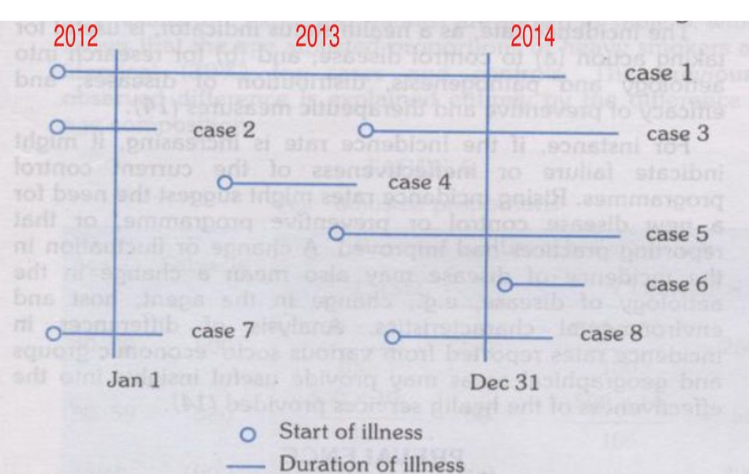
1. List case numbers falling in point prevalence on Jan 1 (0.5)
👉 Cases: 1, 2, and 7
2. List case numbers falling in point prevalence on Dec 31 (0.5)
👉 Cases: 1, 3, 5, and 8
3. List case numbers falling in period prevalence (Jan–Dec) (0.5)
👉 Cases: 1, 2, 3, 4, 5, 7, and 8
4. List case numbers falling in incidence during the year 2013 (0.5)
👉 Cases: 3, 4, 5, and 8
Spotter 2
Question:
In a prospective study of the relationship between oral contraceptive (OC) use and the subsequent risk of developing endometrial cancer, a cohort of 1000 women were followed for 5 years. The results were as follows:
a = 245 → OC users who developed endometrial cancer
b = 75 → Non-OC users who developed endometrial cancer
c = 50 → OC users who did not develop endometrial cancer
d = 630 → Non-OC users who did not develop endometrial cancer
Thus,
a + c = 295 → Total OC users
b + d = 705 → Total non-OC users
n = 1000
Q. What is the incidence rate (absolute risk) of endometrial cancer among those who use oral contraceptives? (2)
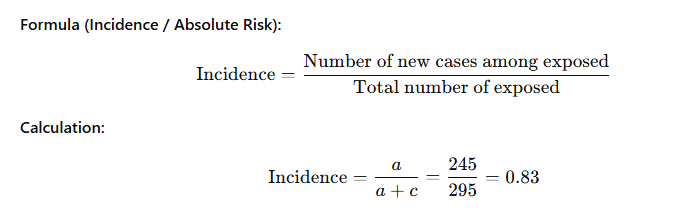
Incidence (absolute risk) of endometrial cancer among oral contraceptive users = 0.83 (83%)
(≈ 830 per 1000 OC users)